Gartner Predicts Agentic AI Will Autonomously Resolve 80% of Customer Service Issues by 2029
Gartner has released a compelling prediction that underscores the transformational power of Agentic AI: by 2029, autonomous AI agents are expected to resolve a staggering 80% of all common customer service issues. This capability goes far beyond simple chatbots, enabling AI to diagnose problems, navigate complex systems, and implement end-to-end solutions independently. This monumental shift will optimize labor costs and ensure seamless, 24/7, high-quality resolution for routine queries.
As Gartner’s prediction becomes reality, WIRPA is preparing women in the automation field to lead the design and integration of these large-scale CX automation platforms, positioning them at the helm of strategic technology initiatives.
Why Agentic AI Represents the Next Frontier in Enterprise Automation
EY argues that Agentic AI represents not just an incremental improvement but a paradigm shift—the next major frontier in automation. Unlike earlier systems, Agentic AI combines complex reasoning, adaptability, and self-correction, making it ideal for managing high-value, ambiguous, and evolving operational workflows. This shift empowers tech companies to reallocate high-skilled talent away from system management and toward core strategic initiatives, a critical factor for success in competitive markets like Silicon Valley.
Embracing the insights from EY, WIRPA is dedicated to cultivating the expertise women need to thrive at this new technological frontier, ensuring they are instrumental in defining the future of AI-driven automation strategies.
Agentic AI and Autonomous Agents: How They Are Reshaping the Process Automation Landscape
The era of rigid, rules-based automation is yielding to a more flexible and intelligent successor. As reported by Daily Host News, Agentic AI and autonomous agents are poised to dramatically reshape how businesses approach process automation. These agents are not just executing code; they are reasoning, adapting, and self-directing to achieve desired business outcomes. This enhances scalability and operational resilience, creating vast new opportunities for efficiency and growth in high-velocity tech firms.
WIRPA focuses on empowering women to become the architects of these next-gen autonomous systems. We are committed to providing the resources necessary for our members to lead in the integration of Agentic AI with enterprise RPA.
The Automation Revolution: 50% of Automated Firms Plan Fast Agentic AI Migration (PYMNTS Analysis)
The next wave of artificial intelligence—Agentic AI—is quickly redrawing the blueprint for automation strategies, particularly in innovation hubs like Palo Alto. PYMNTS data reveals that roughly 50% of companies already leveraging automation plan to aggressively invest and integrate these self-governing AI systems by 2025. Agentic AI moves beyond rigid rules, enabling systems to autonomously plan and execute complex goals, defining the true successor to traditional RPA.
WIRPA believes that mastering Agentic AI capabilities is crucial for women aiming for executive and leadership roles in this rapidly evolving US tech landscape.
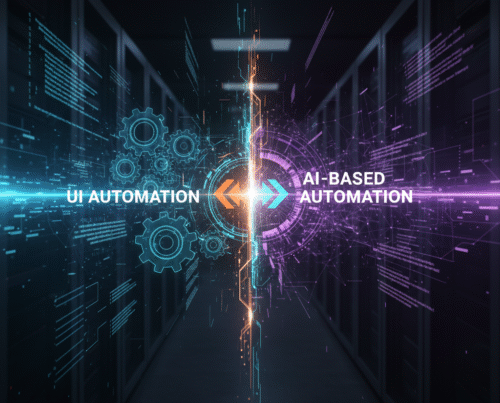
The excitement around AI-driven Agentic Automation doesn’t negate the power of foundational RPA. As articulated by UiPath, the future of automation is not an “either/or” scenario but a sophisticated “both/and” integration. For women building long-term, resilient careers in RPA, understanding how to seamlessly blend traditional User Interface (UI) automation with advanced AI is non-negotiable.
The combined approach creates the most powerful solutions:
1. AI Needs UI: Generative AI agents need reliable methods to interact with legacy systems and external applications. UI automation remains the most robust, non-invasive way to execute the decisions made by an AI agent.
2. UI Needs AI: Traditional bots benefit from AI components (like Document Understanding or Gen AI decision-making) to handle unstructured data and dynamic process changes, elevating their utility beyond simple screen scraping.
3. The Resilient Enterprise: The combination ensures that automation is both smart (via AI) and durable (via UI access to systems).
This requires “T-shaped” skills—deep expertise in both the mechanics of UI automation and the strategic application of AI/ML. WIRPA champions Education to ensure our members are fully cross-skilled, moving beyond tool proficiency to strategic solution architecture. The future belongs to those who can connect the dots between the legacy and the cutting edge.
Are you a “both/and” architect? The market demands proficiency in the integrated automation blueprint. Join WIRPA’s next skill-building session to master the architecture that unites AI and UI for maximum enterprise impact.
The IBM Institute for Business Value (IBV) provides compelling thought leadership on the rise of Agentic Process Automation. Their analysis positions this technology not as an incremental upgrade, but as a foundational change that will redefine enterprise operations, focusing squarely on the value derived from autonomous decision-making.
The report suggests that integrating Generative AI creates “agentic” capabilities that allow automation to:
1. Work with Ambiguity: Traditional RPA struggled with unstructured data; agents thrive on it, interpreting and acting on complex inputs. 2. Enable Hyper-Automation: By allowing agents to self-adjust and coordinate, true end-to-end hyper-automation becomes achievable, connecting disparate systems and processes seamlessly. 3. New Operating Model: This technology necessitates a new organizational structure where human employees collaborate directly with highly intelligent, autonomous agents.
The shift to a human-agent collaborative model is inherently a leadership challenge. Women in RPA are needed to design these new operating models—focusing on change management, skill transformation, and ensuring that the agent’s work enhances human creativity and decision-making. This aligns perfectly with WIRPA’s core value of Collaboration.
How will you redesign your team for the Agentic era? The shift demands leaders who can build bridges between human ingenuity and AI power. Join WIRPA for exclusive workshops on leading human-agent collaboration and defining the future of your enterprise.
Why RPA Leaders Must Embrace Agentic Automation for Maximized Business Value
Why RPA Leaders Must Embrace Agentic Automation for Maximized Business Value
The conversation in the RPA space has fundamentally changed. Leading enterprises are no longer satisfied with simple task automation; they are making a strategic pivot toward Agentic Automation to unlock massive business value. For women leaders in RPA, understanding this pivot is key to securing top-tier positions.
Agentic automation, powered by Generative AI, moves beyond prescriptive “if-then” logic. Instead, it allows for goal-driven, autonomous operation. This means:
1. From Efficiency to Outcomes: Leaders are leveraging agents not just to cut costs, but to achieve specific, high-level business goals (e.g., proactive fraud detection, accelerated time-to-market).
2. Adaptive Processes: Agents handle complexity and unexpected variables, drastically increasing the scope and resilience of automated processes.
3. The New ROI: The return on investment is no longer measured in hours saved, but in strategic competitive advantage and market differentiation.
This pivot requires a change in mindset—from managing bots to orchestrating AI-powered teams. Women leaders are uniquely positioned to excel here, given their strength in holistic, strategic problem-solving and ethical oversight, ensuring these powerful agents align with corporate values. This is where innovation meets integrity.
Is your organization making the pivot? The future of leadership in automation belongs to those who maximize business value through autonomous agents. Join WIRPA to access our resources on AI integration and lead the conversation on maximizing the business value of next-generation automation.
Researchers from the University of Seville have developed an innovative AI-augmented framework designed to enhance robotic process automation (RPA) by integrating it with process mining. This development, published in IEEE Transactions on Automation Science and Engineering, addresses key limitations in traditional RPA implementation.
The Challenge with Traditional RPA
Traditionally, RPA implementation relies heavily on human experts to manually define the processes to be automated. This approach is often described as tedious, error-prone, and subjective.
Furthermore, conventional RPA bots are designed to follow predefined rules and struggle to adapt when business processes or the underlying IT systems change. This rigidity can lead to inefficiencies and automation failures.
The Solution: An AI-Augmented Framework
The new framework leverages process mining techniques to automatically analyze event logs from enterprise IT systems, such as ERP or CRM platforms. This allows it to discover, monitor, and improve business processes in a data-driven way.
How the Framework Operates
The AI-augmented framework functions in three main stages:
Process Discovery: It begins by automatically discovering the as-is process model directly from event log data. This provides an objective view of how processes are actually being executed within the organization.
Conformance Checking: The framework then compares this as-is model against a predefined to-be (ideal) process model. This step identifies deviations, bottlenecks, and inefficiencies, highlighting areas ripe for automation or improvement.
RPA Script Generation: Finally, based on the insights gathered, the framework facilitates the automatic or semi-automatic generation of RPA scripts (the automation logic) that are precisely aligned with the actual processes.
Key Benefits of the AI-Augmented Approach
The researchers, led by José Luis Gámez-Guzmán, highlight several advantages of this integrated model.
“Our framework provides a data-driven and objective approach to RPA implementation, reducing the reliance on manual effort and subjective process definitions,” Gámez-Guzmán explained.
Key benefits include:
The ability to continuously monitor and improve automated processes.
The discovery of new automation opportunities that might be missed by manual analysis.
The optimization of existing RPA scripts based on real-world performance data.
A Step Towards Intelligent Automation
The integration of AI, process mining, and RPA represents a significant step toward more intelligent, adaptive, and efficient business process automation.
This marks a shift from simple rule-based automation to a new generation of data-driven, self-improving automation systems.
Anita, the operations manager at a leading insurance company, was reviewing her team’s performance dashboard over a cup of coffee when she noticed something. Some claims remained pending after the bot flagged for manual intervention.
Her team had implemented Robotic Process Automation (RPA) two years ago, and it had significantly improved process efficiency. Tasks that once consumed hours—data entry, form validations, report generation—were now executed within minutes, and with unmatched accuracy. Employees were no longer bogged down by repetitive work. Customer response times had improved.
The flagged claims highlighted an opportunity for much more sophisticated automation.
Anita found herself wondering.
“We’ve built a rock-solid foundation with RPA. But what if we could give our digital workforce more autonomy? Something—or someone—to handle the judgment calls too?”
To expand the capabilities of RPA, handling more, adapting faster, and elevating outcomes.
That’s when she began thinking beyond task automation. The future was about pairing RPA with new digital teammates—AI agents that could think, reason, and guide.
It was the day when RPA met AI Agents.
And so began their journey into Agentic Process Automation.
Understanding RPA and AI Agents
Let’s rewind for a moment. RPA (Robotic Process Automation) is a software robot that mimics human actions like clicking, typing, and navigating systems to automate rule-based processes. It’s fast, reliable, and has delivered measurable ROI across industries.
But RPA cannot make decisions beyond the rule-based script provided to it. It thrives in structured, predictable environments.
AI Agents, on the other hand, are autonomous, adaptive systems capable of perceiving context, making decisions, and learning from outcomes.
Where RPA handles the doing, AI agents enhance the doing with contextual thinking.
So, when these two technologies come together, agentic enhances the capabilities of RPA, birthing the new chapter in automation: agentic process automation.
Augmenting RPA with Agentic Intelligence
Back at the insurance firm, Anita decided to introduce an AI agent alongside the bots.
Now, when a claim came in with smudged handwriting, the agent:
Interpreted the image using computer vision.
Matched it with policyholder history using machine learning.
Made a decision: Accept the claim, reject it, or ask for clarification.
Triggered an RPA bot to execute the decision in the backend systems.
The result?
Fewer exceptions.
Faster resolution time.
Happier customers—and even more productive bots.
This wasn’t just automation. It was intelligent orchestration.
How Agentic Process Automation Works
Let’s break it down.
RPA:
Predefined workflows
Works on structured data
Rule-based logic
Executes with precision and consistency
AI Agents:
Goal-driven systems that adapt based on context
Handle unstructured data (PDFs, emails, images)
Make autonomous decisions
Learn and improve with feedback
Together:
RPA bots are the hands.
AI agents are the brain.
Agentic Process Automation is not about replacing RPA—it’s about complementing and extending its reach into more complex, decision-heavy workflows.
Some Real-World Scenarios
Process Examples
RPA
APA
Accounts Payable Automation
In retail, RPA extracts invoice data from PDFs, matches them with purchase orders in the ERP, and processes payments. If there’s a mismatch—say the PO number is missing—the bot alerts finance team and a finance team member step in to resolve it manually.
An AI agent monitors incoming invoices and not only extracts the data but also understands when critical fields are missing or misaligned. It cross-references supplier patterns, learns from past exceptions, and intelligently infers the correct PO number or flags truly anomalous ones for further review—while triggering the RPA bot to complete the rest of the payment process.
Insurance Claim Processing
In health insurance, RPA bots collect claim forms, extract relevant data, and input it into the claims system. However, if medical records are scanned, handwritten, or contain unusual formats, the bot routes the case to a human for further review.
An AI agent handles the unstructured data—scanned handwritten doctor notes, medical terms, or new formats—and uses OCR combined with contextual learning to understand what’s being claimed. It makes an informed decision or recommendation and only sends edge cases to human experts. The RPA bot then executes the final claim settlement or communication.
Customer Onboarding in Banking
For every new customer, an RPA bot performs KYC checks, sends welcome emails, and sets up accounts based on a predefined checklist. If a required document is blurry or expired, a representative is required to intervene.
An AI agent reviews the documents and uses image recognition to validate clarity and expiration status. If blurry, it requests a resubmission in a conversational tone via email or chat. It can also tailor onboarding steps based on customer type before triggering RPA bots to complete the setup.
Avoiding the Trap of Agent Washing
Let’s be clear: Not every smart tool is an agent.
Many tools today use fancy language models or decision trees and are marketed as “agents.” But without autonomy, goal orientation, and adaptability, they’re not real AI agents.
According to Gartner, over 40% of agentic AI projects will fail by 2027 due to such over-promising and under-delivering—what the industry calls Agent Washing.
Final Thoughts
Back in her office, Anita looked out the window, reflecting on how far their automation journey had come. The introduction of AI agents unlocked new possibilities.
Now, her digital workforce didn’t just execute. It understood. It adapted. It collaborated.
Her team was building smarter workflows, designing intelligent systems, and finding new ways to create value across business.
The bots continued to deliver speed and consistency. The agents brought reasoning and adaptability.
Together, they formed an ecosystem that was agile, scalable, and future-ready.
And that’s what happens when RPA meets AI agents.
The future of automation is not either/or. It’s together.
Enhancing Cybersecurity with Robotic Process Automation: Navigating New Frontiers
In the digital age, cybersecurity remains a critical concern for organizations across all sectors. As threats evolve and become more sophisticated, the need for robust and scalable security measures intensifies. One technology making significant strides in bolstering cybersecurity defenses is Robotic Process Automation (RPA). This post explores how RPA is transforming cybersecurity strategies, enhancing protection mechanisms, and contributing to a more secure digital landscape.
RPA: A Brief Overview
Robotic Process Automation involves the use of software robots, or “bots,” to automate routine, rule-based tasks that are typically labor-intensive. These bots can mimic human actions in interacting with digital systems, thereby executing tasks faster and with greater accuracy. While RPA’s primary allure has traditionally been its efficiency and cost-effectiveness in operations like data entry and report generation, its role in cybersecurity is quickly becoming equally pivotal.
Strengthening Cyber Defenses with RPA
Automated Security Protocols: RPA can automate repetitive and time-consuming security tasks such as log monitoring, password resets, and security compliance auditing. By handling these tasks, RPA frees up human resources to focus on more complex security concerns, such as threat analysis and incident response.
Enhanced Incident Response: Speed is critical in cybersecurity. RPA bots can be programmed to instantly respond to security breaches or alerts. For example, upon detecting unauthorized access, a bot can automatically initiate protocols to isolate affected systems, minimizing damage.
Vulnerability Management: Bots can assist in vulnerability management by regularly scanning software and systems for weaknesses, applying patches, and updating defenses based on the latest threat intelligence. This proactive approach ensures that vulnerabilities are addressed promptly, significantly reducing the window of opportunity for cyber attackers.
Identity and Access Management: RPA can streamline identity and access management (IAM) by automating user access reviews and processing access requests based on predefined criteria. This reduces the likelihood of human error, which can lead to security breaches.
Addressing Potential Risks
While RPA offers numerous benefits, it also presents unique challenges, especially when bots handle sensitive information. The security of RPA bots themselves becomes paramount. Organizations must ensure that:
Bot Security: Bots are programmed with security in mind, equipped with capabilities to detect and counteract malicious interference.
Access Controls: Strict access controls and authentication measures are implemented for bots, just as with human users, to prevent misuse.
Audit Trails: Comprehensive logging and monitoring of bot activities are necessary to detect anomalies and trace issues when they occur.
Looking Ahead
The integration of AI with RPA is set to further enhance cybersecurity capabilities. AI-enabled bots can learn from past incidents and adapt their responses to emerging threats, providing a dynamic and resilient defense mechanism.
Conclusion
As organizations continue to navigate the complexities of digital security, RPA stands out as a powerful ally. By automating essential cybersecurity tasks, providing rapid incident response, and ensuring continuous compliance, RPA not only strengthens security postures but also enables a more efficient allocation of human resources. The future of cybersecurity is one where human expertise and robotic efficiency converge to combat the ever-growing threat landscape effectively.
Embracing RPA in cybersecurity strategies offers a forward-looking approach to safeguarding critical assets and ensuring business continuity in an increasingly interconnected world.